
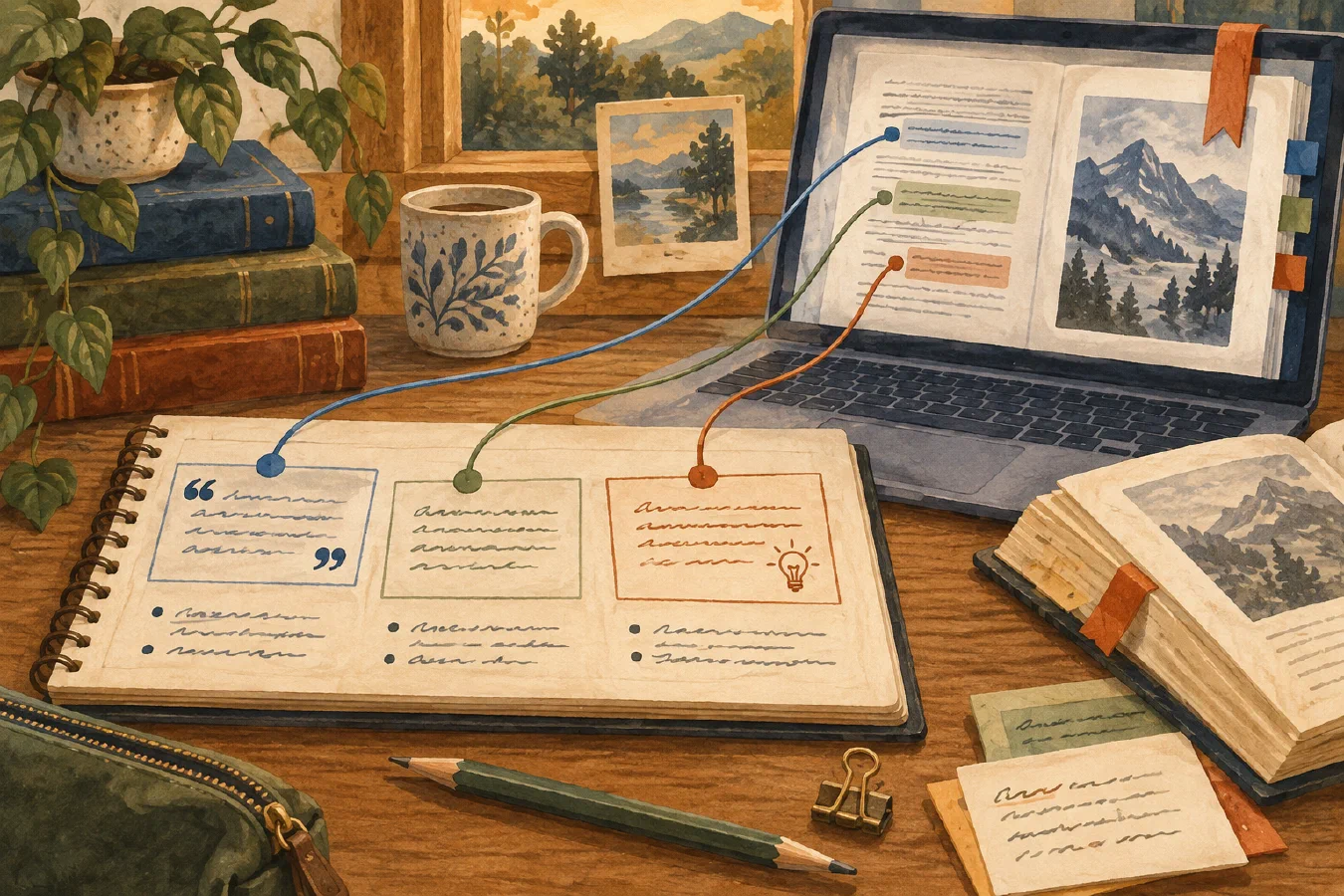
Keep enough context in a research note to return to the evidence later: the source’s identity, the relevant location, what the source says, and how you intend to use it. Separate copied wording from paraphrase and personal interpretation as you read.
The useful test is simple. Close the source, reopen it from the note, and recover the passage behind your claim. If you cannot do that, a polished summary is still missing an essential part of the research work.
Add context to the note you already use
You do not need a new vault or a second reference database. Add the missing information to your existing reading note, document comment, or reference-manager note.
Start with one source relevant to an active assignment. Preserve:
- Identity and route back: enough bibliographic information to distinguish the work, plus a stable link or identifier when available.
- Evidence location: page and section, figure or table, or a descriptive heading for an unpaginated page.
- Your use and its limit: what the passage contributes to your question and what it does not establish.
Record what you have read. “Abstract only” or “methods section not yet checked” is more useful than a complete-looking summary built from guesses. Optional details can wait until they matter.
If you need help deciding where the note belongs, use the guide to note purposes. The research note adds evidence context to that existing system.
Keep source wording and your reasoning visibly separate
Exact copied wording should remain visibly marked as a quotation with its location. A paraphrase uses your own words but still needs attribution. Your inference is a separate statement about what you think follows. Purdue OWL’s quotation, paraphrase, and summary guidance explains the attribution distinction.
Here is a filled synthetic note using the fictional survey from the source-support exercise. It demonstrates note structure and is not evidence for an academic claim:
Source: Synthetic course-survey excerpt in the source-support exercise; not a real study. Location: “Work through a sentence that overreaches.”
Paraphrase: In one course, voluntary quiz users reported reviewing more frequently. Exam performance was not measured.
My interpretation: This raises a question about how quiz use relates to review habits. It does not establish improved grades or a causal effect.
Use: Practice narrowing an overbroad sentence. Do not cite this fictional survey as research evidence.
A real note would identify the actual work and passage. It does not need a summary of every section. Preserve the details needed for the claim you are investigating.
Record a location that survives reopening
A PDF viewer’s page counter may differ from the page numbers printed in the document. Identify which numbering you use when the difference matters. Adding a section heading makes the location easier to recover.
For a web page without page numbers, keep the heading and enough context to locate the passage. For changing documentation, record the relevant version or date checked. A screenshot can preserve an observation, but it does not prove that the current page remains unchanged.
If an authorized local copy is useful, retain its source link and version information. Do not let a renamed PDF become an anonymous file. Follow access and sharing restrictions; saving a private reading copy does not imply permission to redistribute it.
Use a reference manager without confusing its jobs
A reference manager can hold bibliographic data while your reading note preserves your reasoning. Link those records instead of manually maintaining competing copies of the full bibliography. Check imported metadata against the source before relying on it.
If you export records for another tool, inspect what survived. Do not assume that a bibliography export preserves every attachment, annotation, or connection to a word-processing document. Zotero explicitly warns that a library export is not a proper backup.
This article does not require Zotero or an export. If you already use a reference manager, keep its documented backup process separate from any portable notes or bibliography files. The general distinction is covered in sync, Git, and backup.
Reuse the note without overstating what you read
When drafting, open the source again before using a quotation or a consequential claim. Check that the note’s limitation still appears in the sentence you write. If the argument changed, the old passage may no longer be the evidence you need.
Do not cite an original study as though you read it when you only read a review’s description. Retrieve the original or follow the required citation style’s treatment of secondary citation. Keep that access limit visible in the note until it is resolved.
If permitted AI assistance helps organize notes, compare the result with the source. A generated summary remains generated text until checked. Follow course permission and disclosure rules and keep restricted material out of unapproved tools.
Do this now
Open one research note and use it to recover the exact source passage behind its most useful claim.
Log what you learned
Repair the missing link, location, or attribution in that same note. Record a remaining access limit only if it affects later use. The repaired note is the outcome; no separate reflection record is required.