
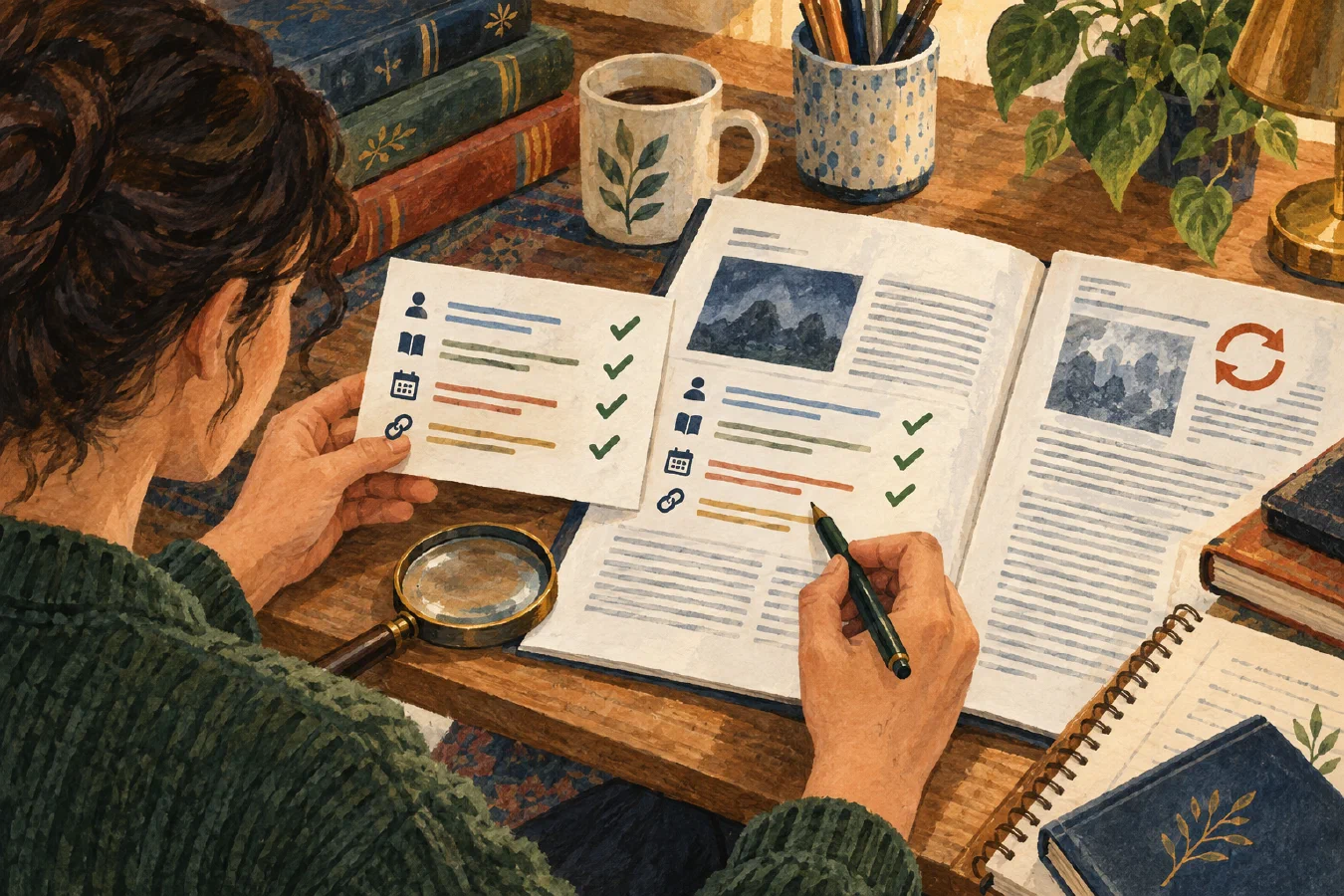
A citation is usable only when you can identify the work it names. Match the reference against an authoritative publication or library record, open the matching work, and check which version you have. Resolve discrepancies before copying the citation into an assignment.
This establishes identity. It does not establish that the work is reliable or supports your sentence. Keep those judgments separate.
Compare the reference with the actual work
Begin with the reference as you received it, whether it came from a class reading, an AI answer, a reference manager, or your own notes. Search the exact title through a publisher, library catalog, or scholarly index. A DOI, when supplied, gives another route to a record.
Compare the title, authors, publication venue, date, and identifier with the work itself. For a chapter, distinguish the chapter author and title from the book editor and title. For a paper, check whether the record is a preprint, accepted manuscript, or published article.
Not every source has a DOI. A book, archival item, official report, or older article can still be identifiable through its bibliographic record. Conversely, a resolving DOI is not a certificate of quality.
Crossref’s metadata documentation describes access to deposited bibliographic information through human-readable interfaces and APIs. Use it as another way to identify a scholarly work. Metadata matching cannot substitute for reading that work.
A real reference you can inspect
For a small identity check, open Gelman and Stern’s paper on statistical significance from the author’s university-hosted publication directory. On the first page, locate the two authors, the journal The American Statistician, the year 2006, and volume 60, issue 4. The article runs from pages 328–331.
Compare those details with the reference you intend to use. The file’s short name, signif4.pdf, is not the article title. Its online location is an access route, not a publication date. These checks identify the paper; evaluating its argument requires reading it.
Handle a mismatch without inventing a repair
The following is a fictional citation problem, not a real reference:
- The title describes a review of classroom quizzes.
- The author and year appear to match that review.
- The supplied identifier opens a different experimental paper.
You now have two candidates, not a verified hybrid reference. Search the title separately, inspect both records, and determine which work you actually need. Do not combine the review’s title with the experiment’s identifier because the result looks complete.
Small discrepancies also need explanation. A publisher may show an online publication date and a later issue date. A repository may hold an earlier manuscript with a different title. Record the version you read, and use the citation rules required by your course. When the relationship is unclear, ask a librarian rather than guessing.
If repeated searches do not locate the work, label it “not located.” That is a limit of your search, not proof that no such work exists. Keep it out of the submitted reference list until you can identify it or replace it with evidence you can inspect.
Check for corrections and other updates
Return to the publisher’s landing page even if you already have a downloaded PDF. Look for a correction, retraction, withdrawal, or linked update. Read any notice that could affect the passage you plan to use.
Where a publisher implements Crossmark, its button exposes reported update information. Crossref explicitly says that Crossmark’s presence is not a guarantee. An absent button or a lack of displayed notices likewise should not be treated as proof that no problem exists.
A correction does not necessarily invalidate every result. Inspect what changed. If a notice affects your intended use, revise the claim, find alternative evidence, or discuss the limitation with your instructor. Do not silently continue citing a superseded result.
Preserve the boundary between identity and support
For one reference, a short note can say:
Identity checked against the publisher record; the PDF is the accepted manuscript. Full text opened. The passage supporting my draft sentence has not yet been checked.
This is an illustrative status note. Use only statements that describe checks you actually performed. “Verified source” is too vague when it could mean anything from a title match to a complete methodological review.
Once identity is resolved, check whether the source supports your sentence. A real paper can be cited for a conclusion it never reached.
When a tool imports the citation for you
Treat imported metadata as a draft reference. Check it against the source before generating the final bibliography. Pay particular attention to item type, author roles, title, and edition or version. A formatted reference can still identify the wrong item.
You do not need to investigate every optional metadata field. Resolve the details needed to identify and cite the work accurately, plus any discrepancy that changes which evidence you are using.
Do this now
Open one source from your draft bibliography and compare its identity with the citation you intend to submit.
Log what you learned
Correct the reference in its existing home. Add a brief version or unresolved-mismatch note only when it affects later use. Keep the source-support check separate until you have read the relevant passage.