
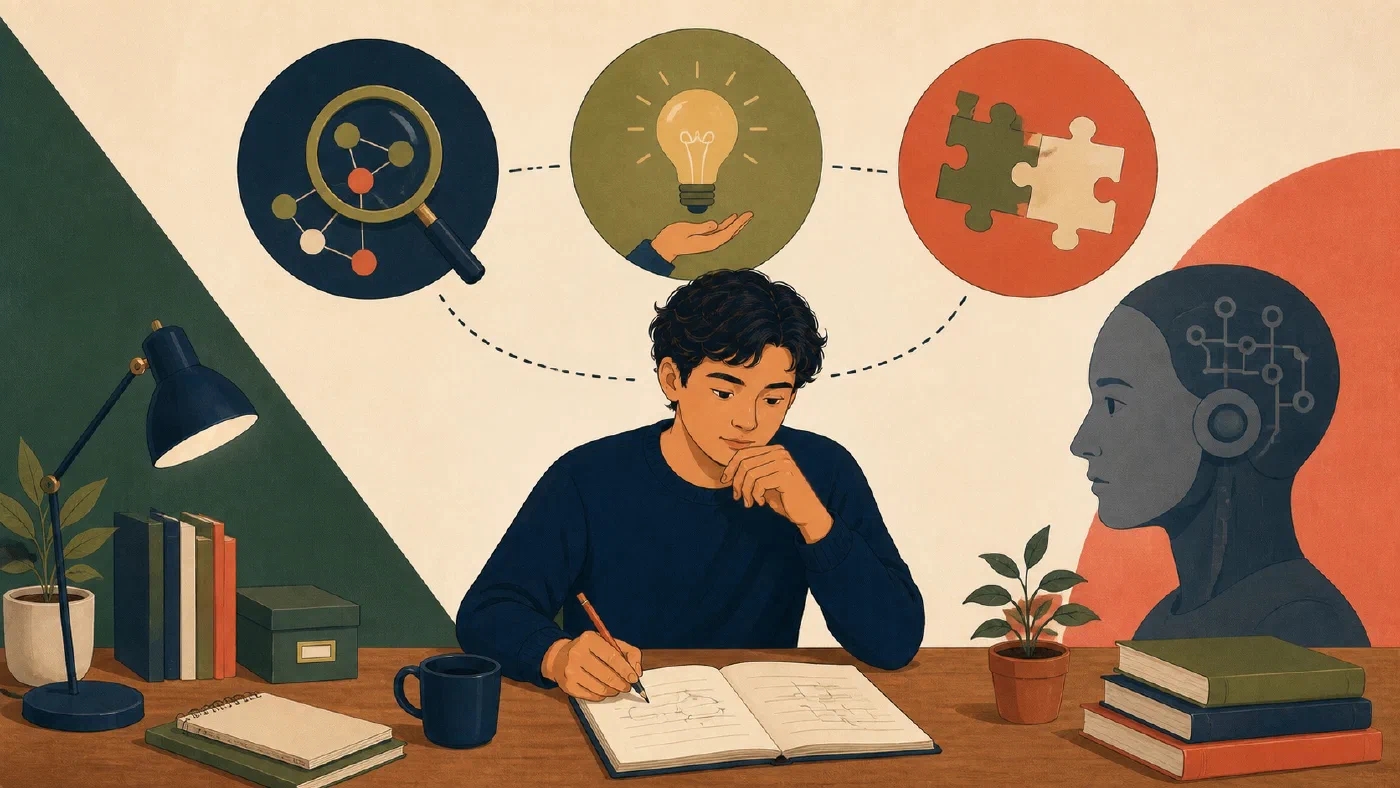
Three human talents are worth deliberate practice alongside AI: broad foundations, initiative, and mental robustness.
This is a practice framework, not a prediction about which jobs will grow or which personality will succeed. The value is immediate. These talents help a student frame better questions, begin worthwhile work, respond to evidence, and remain responsible for AI-assisted results.
Treat them as skills. Build them through dated artifacts and observable actions, not labels such as “well-rounded,” “self-starter,” or “resilient.”
Practice broad foundations
Broad foundations do not mean memorizing a little about everything. They mean having enough durable knowledge across several areas to:
- recognize the kind of problem in front of you;
- use the field’s basic vocabulary;
- ask a useful first question;
- notice when an answer conflicts with a known principle;
- find an appropriate primary source or qualified person; and
- learn the next layer without starting from zero.
A computer science student might connect an AI-generated claim with statistics, security, writing, ethics, or the subject domain where the software will be used. The student does not become an expert in every field. The broader base helps reveal which expertise is missing.
Build connections, not a fact collection
Once a week, choose one concept from current coursework and connect it to another area:
Concept:
Definition in the course:
Related concept from another field:
Where the analogy works:
Where it breaks:
Question I can now ask:
Source or observation used:
For example, a programming student learning input validation might connect it to measurement in a laboratory course. Both require attention to allowed values, units, missing observations, and invalid cases. The analogy breaks when a software rule is treated as evidence about the physical world. The connection should sharpen the question, not flatten the differences.
Use AI to suggest candidate connections if course policy permits. Verify the terms in course material or primary sources, and write the final comparison in your own words.
Evidence of progress
By the end of the semester, you should be able to show:
- several dated cross-domain connections;
- corrections where an analogy or source failed;
- a short list of unfamiliar terms you learned well enough to use accurately; and
- examples of better questions produced by the broader context.
The record matters more than claiming to have broad knowledge.
Practice initiative
Initiative means identifying a worthwhile problem, starting a bounded response, seeking feedback, and following through without waiting for every step to be assigned.
It does not mean being constantly busy, ignoring requirements, or doing unrequested work that creates risk for other people.
Begin with a bounded problem
Write a one-page project brief:
Observed problem:
Who experiences it:
Evidence that it exists:
Smallest useful outcome:
Constraints and permissions:
First action under 30 minutes:
Feedback points:
Definition of done:
Stop or escalation conditions:
A useful student project might be:
Three classmates in a study group repeatedly miss changes to the shared meeting agenda. Create a simple Markdown agenda template, test it in two meetings, and ask the group whether decisions and owners are easier to find.
The project is small, permission-aware, and testable. It does not begin by building an application or collecting personal data.
Use AI without transferring the initiative
AI can help you list risks, critique the project brief, or propose a test. Keep the decisions visible:
- You choose whether the problem is worth solving.
- You verify that the affected people want the change.
- You decide the smallest safe scope.
- You perform or supervise the work.
- You seek feedback from the actual context.
- You decide whether to finish, revise, or stop.
If the AI produces the project idea, plan, implementation, and evaluation while you approve each screen, you practiced supervision of an AI interaction. You did not necessarily practice noticing the problem or defining the work.
Evidence of progress
Keep:
- the original problem observation;
- the first bounded action;
- decisions made before AI assistance;
- feedback requested and received;
- revisions based on evidence; and
- a finished result or a documented reason for stopping.
Finishing can include a justified stop. Initiative includes ending work whose evidence no longer supports the goal.
Practice mental robustness
Mental robustness means responding to manageable uncertainty and setbacks with a deliberate process. It includes sustaining attention, revising a belief, and resuming useful work after an error.
It does not mean tolerating preventable harm, hiding distress, working without rest, or refusing accommodations and professional support. Some obstacles require an instructor, adviser, disability service, counselor, clinician, or other qualified person. Seeking appropriate help is part of responsible action.
Use a response protocol
For an ordinary academic or technical setback, use:
- Pause. Stop repeated changes that produce no new evidence.
- Record. State what happened, what you expected, and what is known.
- Reduce. Identify the smallest next decision or safe test.
- Revise. Change the plan or belief when the evidence requires it.
- Resume or escalate. Continue with a bounded action or seek appropriate help.
Suppose an AI-assisted program fails a test the student expected to pass. Robustness is not rerunning the same prompt until one answer looks acceptable. It is preserving the failure, separating the specification from the generated code, testing one hypothesis, and asking for help when the risk or time boundary requires it.
Protect attention
Set limits before difficulty arrives:
Focused work interval:
Evidence I will collect:
Maximum repeated attempts without a new hypothesis:
Person or resource I will consult:
Condition for taking a break:
Condition for stopping or escalating:
These limits make persistence more precise. They also prevent “keep trying” from becoming a substitute for diagnosis, rest, or support.
Evidence of progress
Record one or two manageable setbacks:
- the initial expectation;
- the observed result;
- the first emotional or technical reaction, stated without judgment;
- the evidence collected;
- the belief or plan revised;
- the support requested, if any; and
- the next action completed.
The goal is not to prove that difficulty no longer affects you. The goal is to show a more deliberate response.
Combine the talents in one project
The talents reinforce one another:
| Project stage | Talent practiced | Observable action |
|---|---|---|
| Frame the problem | Broad foundations | Name relevant concepts and missing expertise |
| Begin safely | Initiative | Write the brief and complete the first bounded action |
| Test assumptions | Broad foundations and robustness | Check a source or result and revise the plan |
| Seek feedback | Initiative and robustness | Ask a specific person a specific question |
| Finish or stop | Initiative | Deliver the defined outcome or record a justified stop |
| Explain the result | All three | Present decisions, evidence, limitations, and next steps |
AI can assist at every stage, but it should not become the only source of the problem, evidence, judgment, or explanation.
Begin with a two-week experiment
Before planning a semester, define one connection, one bounded action, one feedback point, and one review date. Run the experiment for two weeks. Expand only if the first review shows that the practice is useful and manageable.
Expand to a semester after the first review
Adapt this 12-week structure to the length of your term:
| Weeks | Practice | Artifact |
|---|---|---|
| 1–2 | Select one concept each week and connect it to another field | Two connection records |
| 3–4 | Observe problems and choose one bounded project | Problem list and project brief |
| 5–6 | Complete the first action and request feedback | Working log and feedback record |
| 7–8 | Test one assumption and handle one setback with the response protocol | Test record and revised plan |
| 9–10 | Complete, narrow, or stop the project based on evidence | Result and decision record |
| 11–12 | Review the artifacts and explain what changed | One-page practice review |
Keep the workload small enough to coexist with coursework. This plan should support learning, not become another optimization project.
For the final review, answer:
Which connection changed a question I asked?
Which project decision did I make before seeking AI help?
What feedback changed the work?
Which belief or plan did I revise after a setback?
What can I now explain with evidence?
What support or boundary should remain in place?
Common mistakes
- Treating three talents as a universal ranking. They are selected practices, not a complete theory of human value.
- Collecting facts without building usable connections. End each breadth exercise with a question or decision.
- Confusing initiative with unsupervised scope. Respect permissions, privacy, course rules, and affected people.
- Starting a project too large to finish or evaluate. Define the smallest useful outcome.
- Romanticizing stress. Use limits, rest, accommodations, and qualified support when appropriate.
- Calling stubborn repetition persistence. Require new evidence or a new hypothesis.
- Letting AI write the evidence record. Preserve your observations, decisions, corrections, and explanation.
Do this now
Create a two-week experiment with one cross-domain connection, one bounded 30-minute action, one feedback point, and one review date. Do not create the semester table until that review.
You can use the guided chatbot workflow to complete the semester plan one field at a time. Do not let the chatbot choose your project, support boundaries, or evidence of progress.
Log what you learned
The two-week experiment is the learning log. At the review, record the result, evidence, and whether to stop, revise, or expand the practice.
To strengthen the supporting systems, learn how to maintain a personal knowledge base with AI and test an AI-generated claim. If you are choosing an education route, evaluate whether a specific computer science major is worth its cost and alternatives separately from these talents, which can be practiced in any major.