
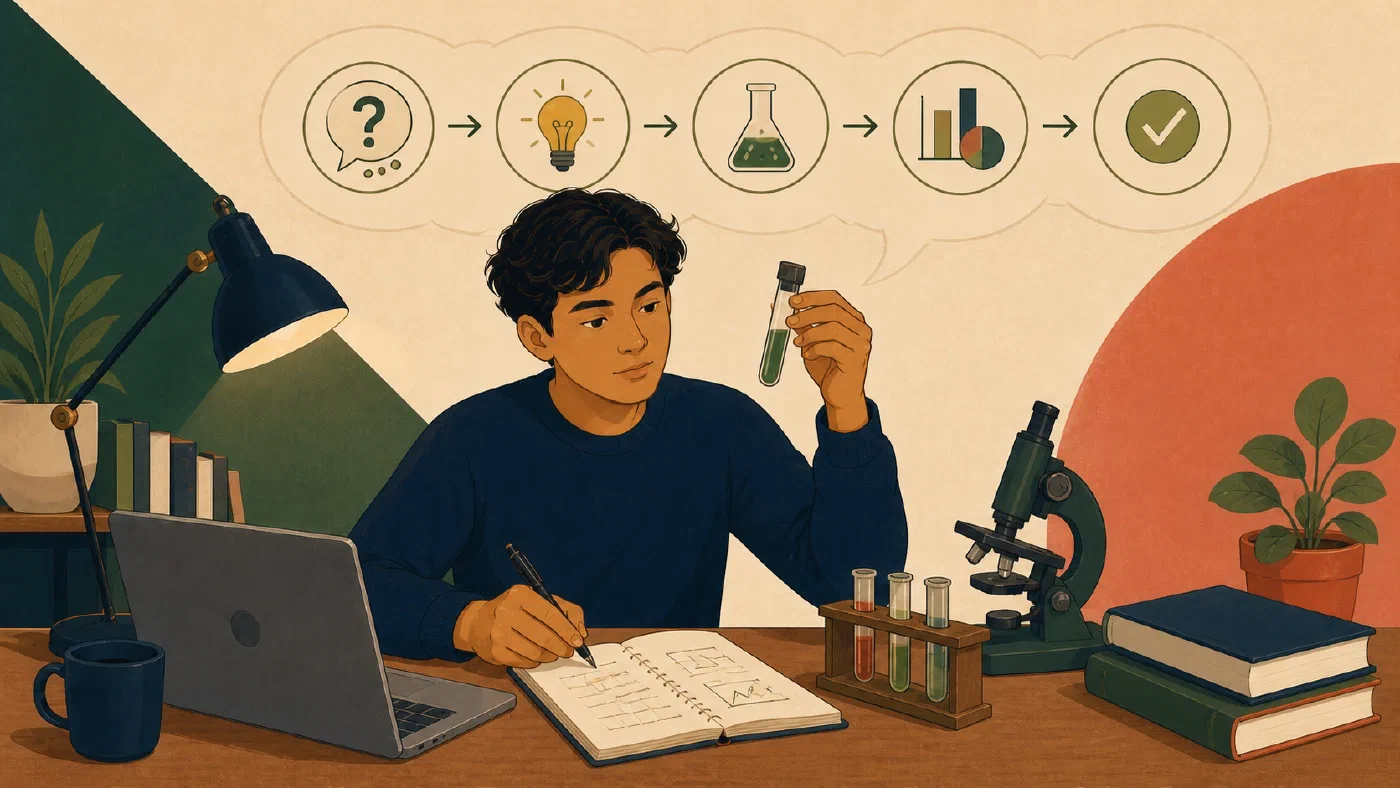
An AI-generated claim becomes useful knowledge only after the evidence supports it. Turn the claim into a testable statement, make its assumptions explicit, decide what observation could contradict it, and choose an independent check appropriate to the decision.
The goal is not to prove that an AI system is generally reliable or unreliable. The goal is to reach a bounded conclusion about one material claim.
Begin with the decision
Verification effort should match the consequence of being wrong.
- A brainstorming suggestion may need no check until you decide to use it.
- A definition for a study note should be compared with course material or an authoritative source.
- A command option should be checked in official documentation and a safe test.
- A prediction should state its time horizon and conditions, then remain uncertain until relevant evidence exists.
- A medical, legal, financial, safety, or security claim needs domain-appropriate authoritative sources and qualified human review.
Write the decision first:
Decision this claim affects:
Consequence if the claim is wrong:
Verification effort justified:
This prevents a low-value detail from consuming an afternoon and a high-consequence claim from receiving only a quick search.
Isolate one testable claim
An AI answer often mixes facts, explanations, recommendations, and predictions. Separate them.
Suppose an answer says:
The
--uniqueoption removes duplicate lines while preserving the order in which values first appear, so it is the best choice for your study list.
This contains at least three claims:
- the option exists for the named command and version;
- it removes duplicates while preserving first-seen order; and
- it is the best choice under the student’s requirements.
The first two can be checked with official documentation and a test. The third is a recommendation that also depends on requirements such as portability, available tools, and whether order matters.
Rewrite one claim with conditions:
For command and version X, option Y transforms input Z into output Q while
preserving first-seen order.
Avoid words such as always, best, or safe unless the conditions make them
meaningful.
State assumptions and a possible contradiction
A claim that cannot lose against any observation is not ready for a useful test. Record:
Claim:
Assumptions:
Observation expected if the claim is correct:
Observation that would contradict or narrow it:
For the duplicate-line example, assumptions may include the exact tool, installed version, operating system, input encoding, and meaning of “preserve order.” A missing option in the official manual would contradict the existence claim. Output in sorted rather than first-seen order would contradict the behavior claim.
This step protects against changing the claim after seeing the result.
Match the check to the claim
Use evidence that is independent of the generated answer.
| Claim type | Useful check |
|---|---|
| Citation or reported fact | Open the primary source and inspect the relevant passage or result |
| API or command behavior | Check official versioned documentation and run a minimal safe example |
| Numerical result | Recalculate with an independent method and check units |
| Program behavior | Derive expected, boundary, and invalid tests from the specification |
| Prediction | Record assumptions, measurable outcome, time horizon, and later observation |
| Recommendation | Compare alternatives against explicit requirements and constraints |
NIST’s Generative AI Profile documents confabulation as confidently presented erroneous or false content. That establishes a reason to verify. It does not tell you whether this particular claim is wrong.
Asking the same AI system to reconsider may reveal a useful counterargument, but it is not independent confirmation.
Write the method before running it
Use a short claim-test record:
# Claim Test

Claim:
Decision affected:
Assumptions:
Source of the claim:
Method:
Expected result if supported:
Result that would contradict or narrow it:
Observed evidence:
Conclusion:
Limitations:
Next action:
For a technical behavior, create the smallest input whose expected result you can calculate without relying on the proposed tool. Use a disposable location and nonprivate data. Record the exact version and command when they affect the result.
Do not write the expected result after running the test.
Classify the conclusion narrowly
Use one of four decisions:
- supported: the evidence matches the claim under the tested conditions;
- corrected: the evidence supports a narrower or different claim;
- uncertain: adequate evidence is unavailable or inconclusive; or
- rejected: the evidence contradicts the material claim.
One supported test does not establish universal truth. A local command test supports behavior for the tested version, environment, and input. A paper may support an average effect under its study conditions without establishing what will happen for every student.
Record limitations next to the conclusion:
Supported for tool version X on three defined inputs. Performance, other
versions, and non-UTF-8 input were not tested.
Know when to stop
Stop when:
- the evidence is sufficient for the stated decision;
- the claim is not material;
- the test would create disproportionate cost or risk;
- qualified review is required; or
- remaining uncertainty has been recorded honestly.
Verification reduces uncertainty. It does not remove every possible error.
Common mistakes
- Testing an entire answer instead of one claim.
- Leaving tool version, units, or other conditions implicit.
- Looking only for confirming evidence.
- Treating a search snippet or AI summary as the primary source.
- Asking the original system to certify its own output.
- Calling one successful example proof.
- Spending more on verification than the decision justifies.
Do this now
Choose one permitted AI response with a material factual or technical claim. Complete the claim-test record. Use at least one independent primary source, calculation, or reproducible observation. Classify the result and state its limits.
The guided chatbot template workflow can help collect the claim, assumptions, method, and observations. The chatbot that helps format the record is not independent evidence for the claim.
Log what you learned
The claim-test record is the learning log. Add observed evidence only after the test runs, then save the conclusion, limitations, and decision.
If the claim concerns an observed software failure, continue with the reproduce–reduce–hypothesize–test debugging cycle.