
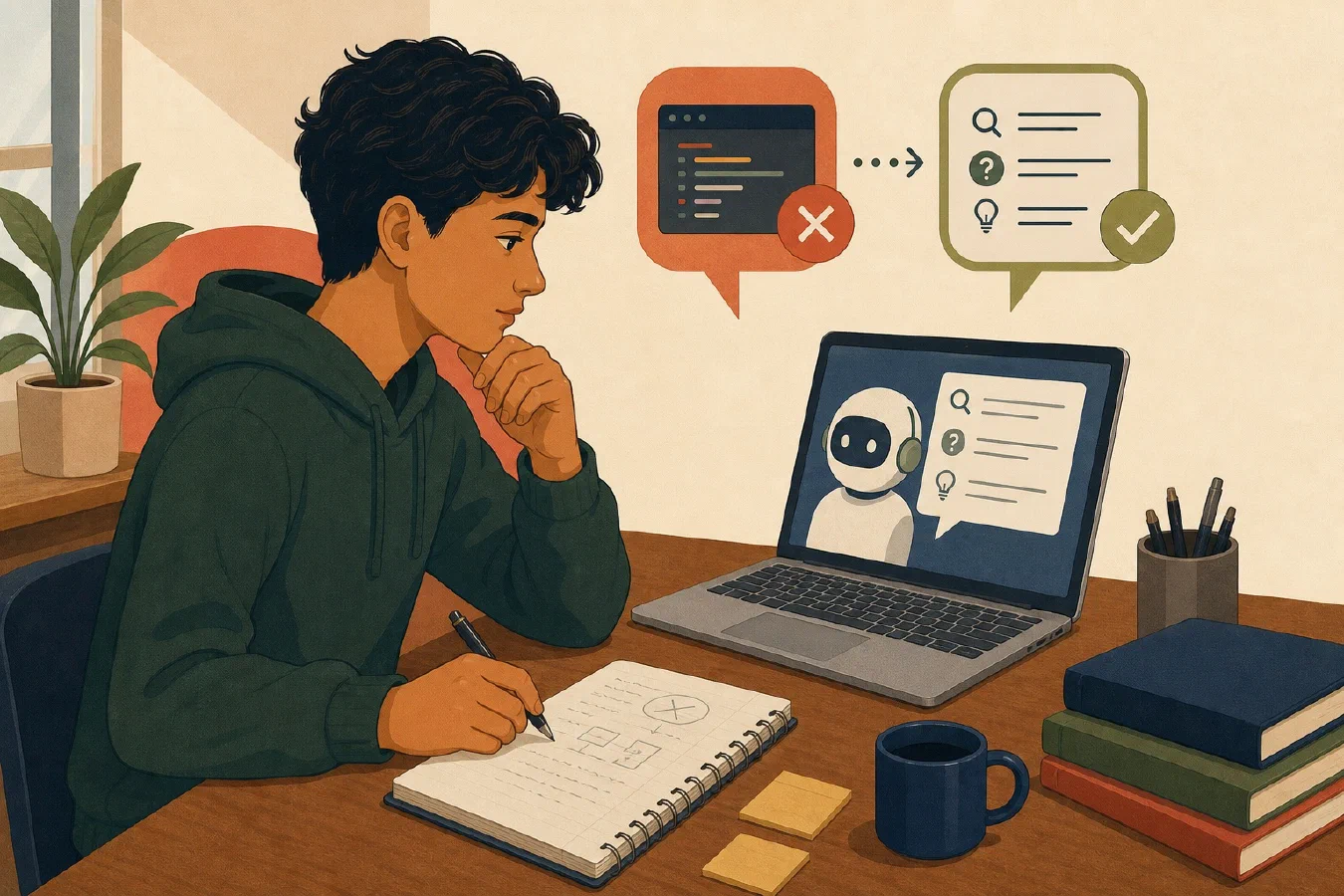
Ask AI to help investigate evidence, not to replace the assignment.
Provide a permitted minimal reproduction, complete error message, expected and observed behavior, and your attempted checks. Request an explanation of the error category, ranked hypotheses, and one inspection step at a time. Do not ask for rewritten assignment code.
Check the course boundary first
Before sharing anything, determine:
- whether AI debugging help is allowed;
- whether assignment text or code may be uploaded;
- whether assistance must be disclosed or cited;
- which tools or accounts are approved; and
- whether the work contains private data.
If the policy is ambiguous, ask the instructor. Remove names, credentials, tokens, private paths, and unrelated course material.
An allowed explanation is not automatically an allowed generated correction. State the boundary in the prompt.
Preserve the complete error
Record:
- exact error type and message;
- relevant stack trace;
- file and line reference;
- command used to run the program;
- tool or language version when relevant;
- expected behavior; and
- observed behavior.
Do not paraphrase IndexError: list index out of range as “the list broke.”
Exact text supports documentation search and distinguishes error categories.
Keep enough stack trace to identify the path to the failure, while redacting private paths or values.
Create a minimal reproduction
A minimal reproduction is the smallest permitted example that still produces the same error. Remove:
- unrelated functions;
- user interface code;
- network access;
- private input;
- large datasets; and
- code that does not affect the failure.
Replace restricted data with small fictional values. Confirm that the reduced example still produces the same error. If it does not, the removed context contains evidence.
Example:
values = [8, 13, 21]

for index in range(4):
    print(values[index])
This six-line practice example is not an assignment solution. It provides an observable boundary error.
State your hypothesis and checks
Before prompting:
Expected: Print three values.
Observed: Prints three values, then raises IndexError.
Known: The list length is 3. The loop produces four index values.
Hypothesis: One generated index is not valid for the list.
Attempted check: Printed index immediately before access.
This keeps the student’s reasoning visible and gives the response something to evaluate.
Request investigation, not replacement
Use:
Do not rewrite the code or provide the corrected loop. Explain what the error
type means in this language. Rank up to three hypotheses using only the evidence
below. Give one read-only inspection or print-debugging step for the first
hypothesis, then wait.

Expected behavior:
Observed behavior:
Complete error:
Minimal reproduction:
Known facts:
My hypothesis:
Checks already attempted:
Course constraint:
If the model produces replacement code anyway, set it aside. Continue from the evidence and official language documentation.
Generative systems can present erroneous content confidently. NIST’s Generative AI Profile calls this risk confabulation. Treat hypotheses as leads to test, not findings.
Test one hypothesis at a time
For the example:
- predict the generated index values;
- print or trace them;
- compare each with valid list indices;
- consult the language documentation for
rangeand indexing; and - state the correction in your own words.
Do not make several speculative edits. A single targeted check preserves cause and effect.
After correcting the practice example, test:
- empty input if the assignment permits it;
- one element;
- the original three elements; and
- a larger ordinary case.
The exact cases depend on the specification. Do not add behavior the assignment does not require.
Preserve the student’s approach
AI may suggest a different library, algorithm, or complete design. That can violate course requirements or bypass the intended concept.
Include:
Preserve:
- the required loop form;
- the function interface;
- permitted language features;
- my overall approach unless evidence shows it cannot meet the specification.
Ask the model to identify which assumption fails before proposing an alternative. Discuss a material design change with the instructor when the assignment constrains the method.
Explain the result independently
The debugging session is incomplete until you can answer:
- What condition caused the error?
- Which observation supports that conclusion?
- Why does the correction address the cause?
- Which test would catch a recurrence?
- What remains uncertain?
Close the chat and reproduce the diagnosis from your working log. If you cannot, return to the first unexplained step.
Common mistakes
- Pasting the complete assignment. Share only permitted minimal context.
- Omitting the exact error. Preserve its text and relevant trace.
- Asking “fix this.” Request hypotheses and inspection.
- Changing several lines. Test one cause.
- Accepting a different algorithm. Preserve required constraints.
- Treating a plausible diagnosis as verified. Run a focused check.
- Submitting generated explanation as your own. Follow disclosure and authorship rules.
Do this now
Create a minimal reproduction for one permitted error. Complete the prompt, ask for one investigative step, test it, and explain the result without the chat.
Log what you learned
Record only:
- Result: What did the action produce?
- Evidence: What observation, test, or source supports that result?
- Next action or unresolved question: What should happen next?
Next, learn how to review AI-generated code before accepting it.