
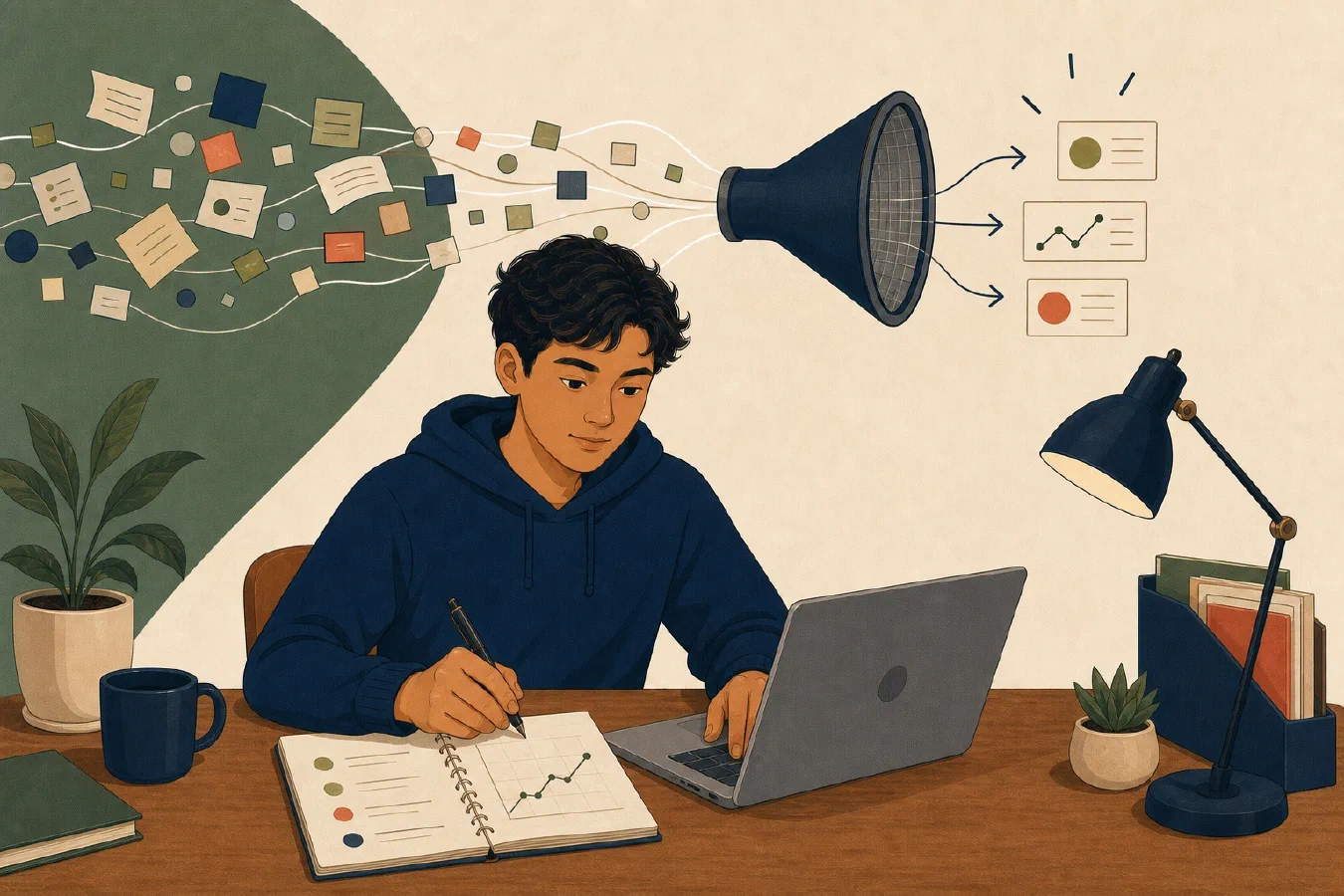
Follow AI updates by monitoring the questions, tools, and rules that already affect your work. Do not try to follow the whole field. Keep a small register of first-party sources, review it at a fixed time, and investigate only changes that could alter a real course or workflow.
The output of the review is a decision, not a larger reading list. For each material update, decide to ignore, monitor, trial, or adopt.
Start with watch questions
A source deserves your attention only when it can answer a question you already have. Write three to five watch questions such as:
- Is a tool used in one of my courses changing or being retired?
- Did an API or file format in one of my projects change?
- Did my institution or instructor revise an AI-use rule?
- Is there new evidence that challenges a method I currently rely on?
- Did a tool add a capability that may solve a problem recorded in my working log?
These questions create a boundary. A new image generator may be impressive, but it does not require investigation when none of your current work uses image generation.
Avoid watch questions such as “What is new in AI?” They cannot produce a stopping condition.
Match each update type to a primary source
Different claims need different sources.
| Update type | Start with | What it can establish |
|---|---|---|
| Product behavior | Official documentation, release notes, status pages, and deprecation notices | What the provider says changed, where, and when |
| Model evidence | Technical reports, model or system cards, and original evaluation results | What was measured under stated conditions |
| Research result | The original paper, data, code, and correction record when available | What the study reports, not whether it generalizes to your work |
| Policy or standard | The issuing institution, government body, standards organization, or course policy | The actual rule, scope, effective date, and authority |
| Commentary or prediction | The underlying sources cited by the commentator | Context or interpretation, not confirmation by itself |
For example, OpenAI maintains ChatGPT release notes, and Google maintains a Gemini API changelog. These are useful records of provider announcements. They do not independently prove that a feature is reliable, available to every account, or useful for learning.
For public standards and risk-management work, follow the responsible agency instead of a summary account. The NIST artificial intelligence program links to its current AI frameworks, evaluation work, standards activities, and related updates.
An official source can still be incomplete for your decision. It establishes what the issuer says. A consequential capability claim may also need a reproducible test or independent evidence.
Keep a small source register
Register one source for one current watch question. Add more only when they cover a distinct question; use no more than six sources at first.
# AI update source register

## Watch question
Which changes could affect my data-analysis course project?

## Source
- Name:
- Official URL:
- Update type:
- Why it is primary for this question:
- Review frequency:
- Last checked:
- Remove when:
Include the official release notes for a product you actually use, the policy page for a relevant course or institution, and the publication page for a research area you are actively studying. Do not add a general AI news feed unless it repeatedly helps you locate primary material you would otherwise miss.
Interpreters can be useful for discovery and technical context. Keep only a small number whose work links to primary sources, distinguishes evidence from opinion, corrects errors, and explains uncertainty. Verify material claims at the source.
Review on a schedule
Reserve one short block each week or every two weeks. Twenty minutes is enough for a first system:
- Open each registered source.
- Scan entries since the previous review.
- Discard updates unrelated to a watch question.
- Create a change record for each potentially material update.
- Stop when the time block ends.
Use urgent notifications only for a narrow operational reason, such as an announced shutdown date for an API used by an active project. Most capability announcements can wait for the scheduled review.
Continuous feeds make every announcement compete for immediate attention. A schedule makes relevance the admission rule.
Classify before you react
Triage a potentially material update with five fields:
# AI change record

Claim:
Primary source and applicable conditions:
Watch question affected:
Decision: ignore | monitor | trial | adopt
Reconsider when:
Add product, plan, region, platform, version, or rollout details only when they change applicability. The conditions field matters. “Available” may mean a preview on one platform, in one region, for one account type, with a staged rollout. “Improved” may refer to one benchmark and metric. “Required” may apply only to one course or institution.
Separate five statements:
- Announcement: the organization says something changed.
- Availability: the change is accessible under stated conditions.
- Capability: the tool can perform a defined task.
- Reliability: it performs the task consistently enough for your use.
- Value: using it improves an outcome you care about at an acceptable cost.
One announcement does not establish all five.
Test only a material change
A bounded test is justified when the update could change a current decision and the test is safe, permitted, and proportionate.
Define the test before opening the new feature:
Current workflow:
Proposed change:
Representative low-risk input:
Expected useful result:
Failure or unacceptable trade-off:
Evidence to record:
Rollback:
Time limit:
Use fictional, public, or otherwise permitted material. Do not upload graded work, private student records, credentials, unpublished research, or restricted course content merely to try a feature.
Compare the new method with the current one on the same task. Check output quality, errors, time, data handling, export, accessibility, and the work needed to verify the result. A polished demonstration is not a substitute for your representative case.
When the announcement contains a consequential factual or technical claim, test the claim with explicit assumptions and independent evidence.
Make one of four decisions
- Ignore: The update does not affect a watch question. Keep no detailed record unless the reason will prevent repeated reconsideration.
- Monitor: The update could matter later, but availability, evidence, need, or course permission is missing. Record the condition that would justify another look.
- Trial: A bounded test could resolve a current decision. Define the task, limit, evidence, and rollback before investing more time.
- Adopt: The change passed the test, fits current rules and requirements, and improves a real workflow. Update the relevant documentation and preserve an exit path.
Do not interpret “monitor” as “read everything about it.” It means waiting for a specific condition.
If a trial looks promising, use a separate AI-tool learning audit before investing deeply.
Remove sources that do not change decisions
Review the register once a month. Remove a source when it:
- does not answer an active watch question;
- mostly repeats another registered source;
- rarely links to primary evidence;
- mixes advertisements and evidence without clear labels;
- produces saved items but no decisions; or
- covers a tool or project you no longer use.
Also remove obsolete watch questions. A monitoring system should become smaller when a course ends or a project is archived.
The goal is not perfect awareness. The goal is timely awareness of changes that can alter work you are responsible for.
Common mistakes
- Following personalities instead of primary sources.
- Treating a product announcement as independent evaluation.
- Confusing a preview with broad availability.
- Saving articles without recording a decision.
- Testing on private or assessed material.
- Adopting a feature before checking export and rollback.
- Automating alerts before the manual filtering rules are stable.
- Spending more time monitoring a tool than using or learning from it.
Do this now
Write one watch question and register one primary source. Set a 20-minute review
appointment. During that review, complete one triage card and decide to ignore,
monitor, trial, or adopt. Create a trial plan only for a trial decision.
Use the guided chatbot workflow if you want to build the source register or change record one field at a time. Verify every update against the primary source rather than treating the chat as evidence.
Log what you learned
The source register and triage card are the learning log. Add trial evidence only if you run a trial, and remove sources that do not inform decisions.